Draw the rest of the owl
This is an AI-powered interactive version of a classic meme. While supplies last.
1. Draw some circles
2. Draw the rest of the owl
The joke of the original meme is, of course, that the given instructions are clearly not sufficient to instruct on the difficult task of drawing an owl. However, in this age of prompting, it seems it doesn’t quite apply anymore. Draw the circles, give some instruction - and AI will happily draw the rest of the owl. As long as you can draw some circles, you too can now participate in the owl scene. Depending on who you ask, there’s at least two ways this new era could shake out:
- A renaissance in owl-based art, due to the lower barrier of entry. New contributions pour in at a rate never before seen, from entirely new artists - and art abounds. Skill and effort are no longer gatekeepers of anything - but taste is king.
- The disenfranchisement of traditional owl-based artists, who are now useless and purposeless and ashamed and will have to work in coal mines and cruises to make ends meet. Owl art homogenizes into a depressing monoculture until no one cares.
Those are the primary two outcomes as far as I can see. Here’s an ad I spotted on the subway which alludes to these two paths in a single well-crafted slogan:
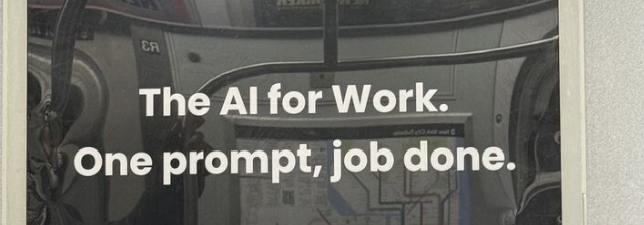
Does the term “job” refer to some small task you’re working on… or does it refer to your employment itself? Is it that THE JOB is done… or YOUR JOB is done?
Now - marketers are a bunch of sneaks, and don’t mind ruffling feathers if it gets people talking. I’m sure they carefully crafted this ambiguity just to get you riled up, so let’s not dwell on it too long.
Still, it begs the question: could your job truly be completed by one prompt? Then the only job that remains for you, or for any of us, is prompter? That doesn’t make much sense - since we’ve already established from the owl meme that the prompt is the easy part that anyone can do!
Art, Expression & Compression
Let’s move away from owls and AI for a minute and look at some real-deal art. Take a gander at Svetlana Zakharova’s performance of The Dying Swan. At a high level, you can admire the choreography and the athleticism required to execute it. But look closer - the specific way she holds her fingers during a turn, how some movements look weightless, and some look strained. The emotional depth of the performance is revealed through some of the smallest choices in her movements - ones that are hardly even perceptible. Like pixels on a screen, each detail is minuscule, but combines to create a high-definition portrait that is rich and engaging.
This is true of lots of art - dancing, singing, acting, painting, writing. In all of these, a single work contains a hidden temple filled with the artist’s unique and personal choices. Many of these details are unintentional; a watermark of your style and substance is embedded when you belt a note, hold a brush, or write a contrived metaphor. Great artists will imbue each of these details with intentionality - but either way, the resulting work is a part of the artist, concealed.
In order to give the illusion of credibility, I’ll sloppily borrow concepts from Information Theory. I would argue that human communication has a substantially underrated signal-to-noise ratio. The signal isn’t just the contents of the message (“A sad dance about a dying bird”) - but what the author’s tone, style, word choice, and pacing reveal about themselves, who they are, how they think - often in ways that words are not equipped to describe. There is an intimacy associated with seeing someone’s special details that they couldn’t help but reveal in their expression. In this day and age, intimacy can be hard to come by.
This is why it can be exhausting to read LLM prose. Not because the writing is technically worse in any measurable way. It’s simply tedious because there is no person on whom these subtle details shed light. Once it’s determined to be machine-generated, all the style and tone cease to carry any information we could care about. The signal-to-noise ratio drops dramatically, and you’d rather just read the prompt to gain back some information density and move on with your day.
Back to the owls
The circles you added in the tool above? There are only a few million combinations of those two circles. That might sound like a fair bit, but if everyone on Earth used this toy, we’d have millions of repeated owls (and I would have a very large OpenRouter bill). However, putting pen to paper (or in this case, finger to phone) results in a mathematical explosion of possibilities. There are unfathomably more owls able to be drawn than there are atoms in the known universe.
I guess what I’m saying is - go ahead try to draw the rest of the owl - why not? Consider yourself prompted. Your owl drawing will be worth far more to me than the perfect one above - because it reveals something about you as a person… even if it just reveals “this guy can NOT draw an owl to save his life”.
2. Draw the rest of the owl
Thanks for reading!
PS - I had to significantly cheat the AI owl-generator since no combinations of text prompt + circles resulted in good owls. Here’s cheat-mode where you can see what happens behind the scenes when you create an owl.